
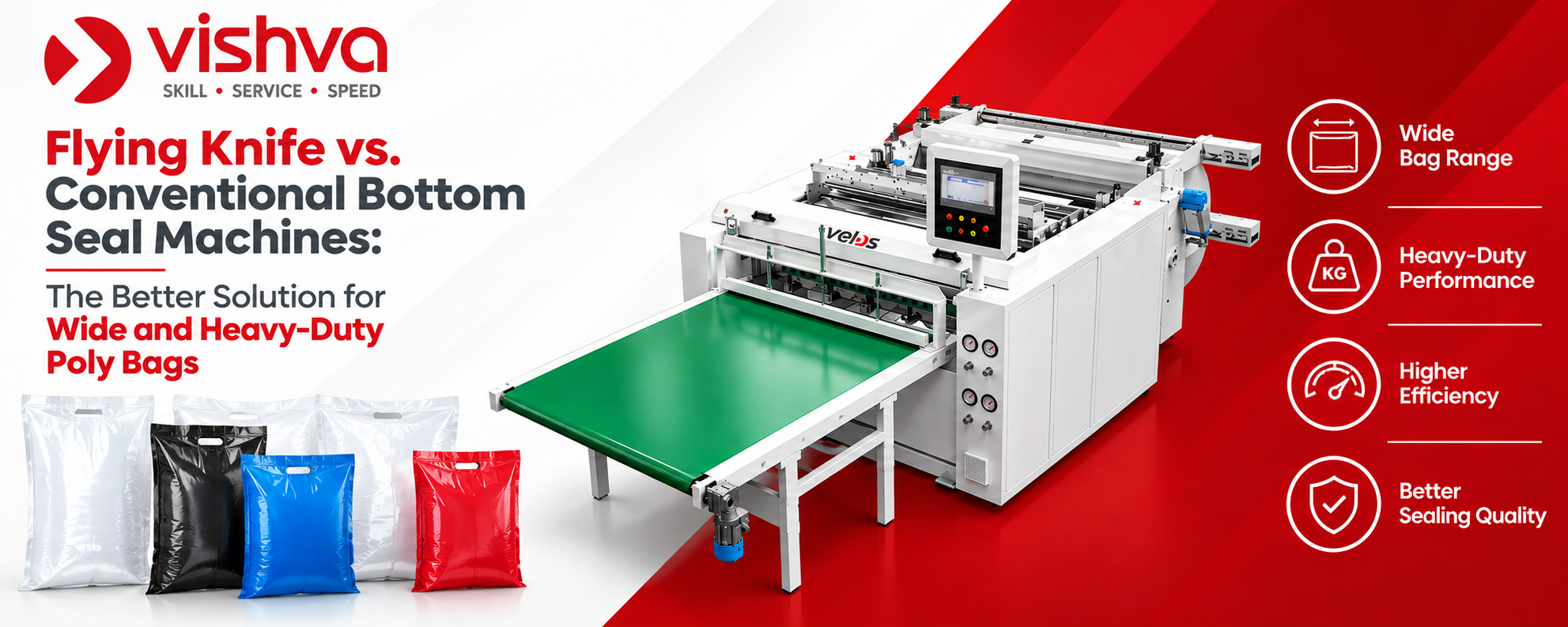
Plastic bags and sacks remain one of the most widely used flexible packaging formats across the world. They are used across industries ranging from food and agriculture to retail, waste management, industrial packaging and e-commerce.
The global plastic bags and sacks market is estimated at approximately USD 22–27 billion, depending on market definition and methodology. Grand View Research estimates the market at USD 23.5 billion in 2023, with the market projected to reach USD 34.2 billion by 2030, representing a CAGR of approximately 5.5%. Asia Pacific accounted for around 43% of global revenue in 2023. (Grand View Research)
Within the broader plastic bags and sacks industry, bottom-sealed bags represent an important category of industrial and commercial packaging. These bags are widely used for applications such as:
For manufacturers producing polyethylene (PE) bottom-seal bags, there are broadly two machine technologies used for cutting and sealing:
While conventional bottom-seal machines remain suitable for many standard applications, the Flying Knife system offers significant advantages when producing wider, longer and thicker bags.
The biggest difference between the two systems is the way the bag is cut.
A conventional bottom-seal machine generally uses a shear cutting mechanism, where a blade moves across the film to make the cut. This works effectively for standard-width and relatively thinner films.
A Flying Knife machine uses a knife mounted on a timing-belt system, allowing the knife to travel rapidly across the film while maintaining controlled and precise movement.
This becomes particularly important as bag width and film thickness increase.
When working with bags wider than approximately 1,000 mm, a conventional shear blade has to span a significantly larger distance. Blade deflection or bending can become a concern, particularly when the machine is being set up or when cutting heavier films.
This can result in:
The Flying Knife mechanism addresses this challenge through its mechanically guided knife movement.
In Vishva Flying Knife Bottom Seal Machines, the Flying Knife system is servo driven.
The servo drive gives the operator significantly greater control over the cutting movement, timing and synchronization of the knife.
This is particularly useful when running:
Instead of relying only on a conventional mechanical cutting movement, the servo-controlled system allows the cutting operation to be precisely synchronized with the machine cycle.
The result is a more controlled and repeatable cutting process.
Another important advantage of the Flying Knife system is the use of surgical blades.
These blades are designed to provide a sharp and precise cutting edge and are particularly effective when processing thicker polyethylene films.
For applications involving films of 100 microns and above, conventional cutting systems can become more demanding to operate. Cutting performance can depend heavily on blade condition, alignment and machine settings.
The sharp edge of the surgical blade allows the Flying Knife system to cut thicker material with precision.
This makes the technology particularly suitable for manufacturers producing heavy-duty bags and liners.
Blade maintenance is an important consideration for any bag-making machine.
Conventional shear blades generally require grinding or sharpening when their cutting edge becomes dull. Depending on the blade design and application, this can involve additional maintenance time and expense.
The surgical blades used in the Flying Knife system are comparatively inexpensive and can be replaced quickly.
For an experienced operator, blade replacement can take approximately five minutes, depending on the machine configuration and operator skill.
This provides several practical benefits:
For manufacturers running multiple shifts, these small improvements in maintenance can contribute to meaningful productivity gains over time.
One of the most important advantages of the Flying Knife system is its ability to process thicker polyethylene film.
Vishva's Flying Knife Bottom Seal Machine is designed to efficiently seal and cut single-layer films up to approximately 250 microns, depending on the material, bag dimensions and application.
Conventional bottom-seal machines using standard shear cutting and heat-seal technology are generally more comfortable in lower thickness ranges, with practical performance often becoming more challenging around 120–150 microns, depending on the machine and material.
This makes the Flying Knife system particularly relevant for manufacturers producing:
Cutting is only half of the process. A high-quality bottom-seal bag also requires a strong and consistent seal.
The Flying Knife system uses a Nichrome wire impulse sealing mechanism rather than a conventional heat-seal bar.
Impulse sealing is particularly advantageous when working with thicker polyethylene films because the sealing process can be precisely controlled through electrical heating of the Nichrome wire.
The technology is widely suited to applications where strong and reliable seals are required on thicker films, including large liner bags and heavy-duty garbage bags.
For manufacturers working with films approaching 250 microns, the sealing system becomes an important part of the overall machine design.
Bag dimensions are another area where Flying Knife technology offers an advantage.
Vishva Flying Knife Bottom Seal Machines can be configured for producing bags of up to approximately:
3 metres in length × 1.5 metres in width This opens up applications that are difficult or impractical on conventional bottom-seal machines designed around smaller bag dimensions.
By comparison, conventional bottom-seal configurations are commonly used for bags around 1.2 metres in length and 1 metre in width, although actual limits vary according to machine design and manufacturer.
The ability to manufacture larger bags makes the Flying Knife system particularly useful for industrial and heavy-duty packaging.
Not every bag-making application has the same requirements.
Standard shopping bags or relatively thin packaging may not require the capabilities of a Flying Knife system.
However, when the application demands large dimensions, high film thickness, strong seals and consistent cutting, machine selection becomes much more important.
Flying Knife Bottom Seal Machines are particularly suitable for applications such as:
| Feature | Vishva Flying Knife System | Conventional Bottom Seal |
| Cutting System | Flying Knife | Conventional Shear |
| Knife Drive | Servo Driven | Conventional Mechanical System |
| Blade Type | Surgical Blade | Shear Blade |
| Wide Bags | Excellent suitability | More challenging at wider widths |
| Thick Film | Up to ~250 microns* | Typically more suitable for lower thicknesses |
| Sealing System | Nichrome Wire Impulse Seal | Heat Seal Bar |
| Maximum Bag Size | Up to 3 m × 1.5 m* | Typically up to ~1.2 m × 1 m* |
| Blade Maintenance | Quick blade replacement | Blade grinding/sharpening |
| Heavy-Duty Bags | Highly suitable | Application dependent |
| Large Liners | Highly suitable | More limited |
*Actual performance and dimensions depend on machine configuration, material properties, film structure, bag dimensions and operating conditions.
The conventional bottom-seal machine remains a practical solution for standard bag-making applications.
But as manufacturers move toward wider bags, longer bags and thicker films, the limitations of conventional shear cutting and heat-sealing systems become more significant.
The Flying Knife system addresses these challenges through a combination of:
Servo-driven cutting + Surgical Blade + Timing-Belt Guidance + Nichrome Impulse Sealing
Together, these technologies provide a machine platform designed for demanding bottom-seal applications.
For manufacturers producing large liner bags, heavy-duty garbage bags, rice bags, pet food bags and other industrial packaging, the Flying Knife system can provide greater flexibility than a conventional bottom-seal machine.
The choice between a conventional bottom-seal machine and a Flying Knife Bottom Seal Machine ultimately depends on the type of bags being produced.
For standard-width, thinner bags, a conventional shear-cutting system may be sufficient.
However, when production requirements include widths above 1,000 mm, film thicknesses above 150 microns, large bag dimensions or demanding sealing requirements, Flying Knife technology offers a significant technical advantage.
With servo-driven Flying Knife cutting, surgical blades, Nichrome impulse sealing and the capability to produce bags up to approximately 3 metres long and 1.5 metres wide, Vishva's Flying Knife Bottom Seal Machine is designed for manufacturers looking beyond conventional bottom-seal production.
When the bag gets wider, thicker and larger, the cutting and sealing technology needs to evolve with it.